Why Your Screenplay Needs End-to-End Encryption
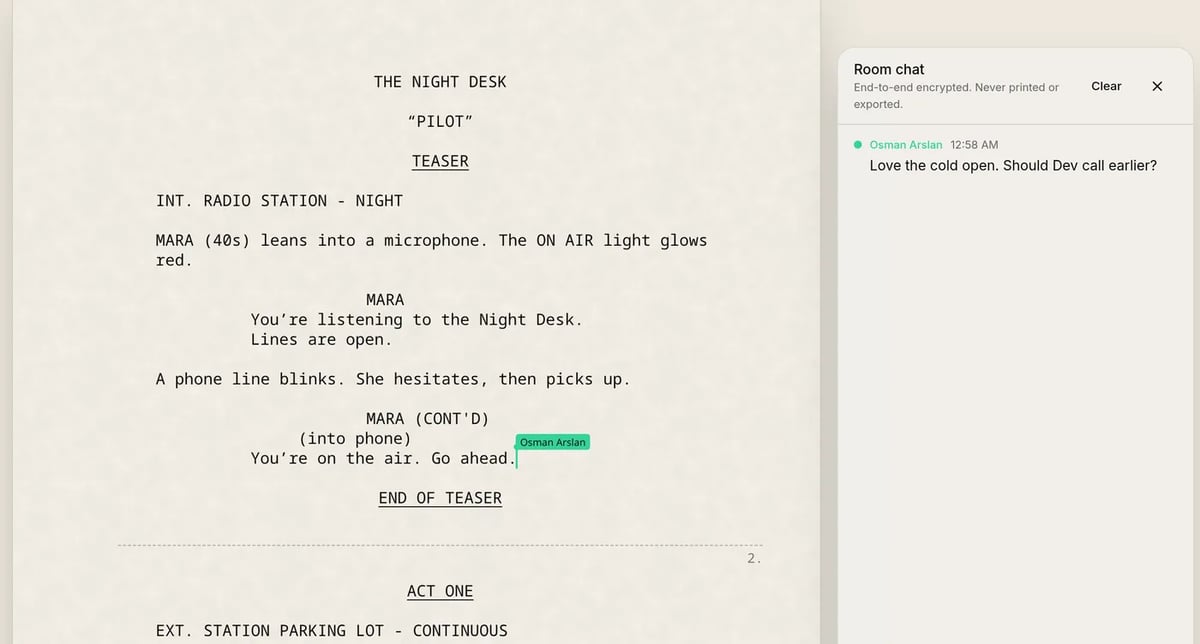
A screenplay has a strange life. For months it belongs to one person, sometimes two, and nobody else in the world has read a word of it. Then, almost overnight, it starts traveling. A trusted reader gets a draft. A co-writer gets edit access. A manager forwards a PDF. A contest receives it. If it gets made, it ends up in the hands of producers, actors, department heads, and eventually a crew of dozens.
Most writers think carefully about the second half of that life: who they send the script to and when. Far fewer think about the first half, the months when the draft lives inside a writing app, on a company's servers, in a form that someone other than the writer could open. That part of the journey used to feel safe by default. Two things have changed that: breaches that reach the entertainment industry, and an AI industry that has shown how much it wants film and TV writing.
This piece walks through what actually protects a script, what the word "encrypted" really means when an app says it, and how working writers can protect their pages at every stage, from the first scene heading to the shooting draft.
The industry already treats scripts as sensitive. Writers usually don't get the same protection.
Anyone who has worked on a larger production knows the routine. Scripts go out as watermarked PDFs with the recipient's name stamped across every page. Copies are numbered and tracked. Sides handed out on set are collected at the end of the day. On high-profile shows, actors and crew sign NDAs before they see a page, and some scripts are only readable inside secure viewing platforms.
None of that exists for the writer at the development stage. The spec you're writing on weekends, the pilot you're co-writing over video calls, the feature you're polishing before the contest deadline: these usually live in a consumer writing app with an ordinary account and an ordinary password. The script is at its most personal and, for a working writer, often its most valuable, and it has the least protection it will ever have.
The risk is real, and it isn't new
In late 2014, hackers broke into Sony Pictures and stole a huge amount of internal material. Among it, as the producers of the James Bond films confirmed at the time, was an early version of the screenplay for Spectre. If one of the biggest franchises in the world can lose a script to a breach, a writer with an unproduced pilot should at least know where their pages live and who can open them.
That same year, Quentin Tarantino said he was shelving The Hateful Eight after the script leaked from the small circle of people he had shared it with. He went on to make the film anyway, but the episode showed something every writer should remember: a script is only as private as the least careful place it sits.
The threat has also changed shape. In late 2024, The Atlantic reported that subtitle dialogue from well over 100,000 films and TV episodes had been gathered into a dataset used to train AI models at several major tech companies, without the writers' knowledge. That was dialogue from finished, released work. Unpublished scripts are a different case, but the lesson carries over: writing that can be read can be collected.
Writers have noticed. The Writers Guild of America's 2023 agreement with the studios added protections around artificial intelligence, including that AI can't write or rewrite literary material, and the guild reserved the right to argue that using writers' material to train AI is prohibited. Who can read a writer's work, and what they're allowed to do with it, is now part of the business of screenwriting.
Three kinds of "encrypted"
Almost every writing app says your work is encrypted. That single word covers three very different things, and only one of them keeps the company itself out of your script.
Encrypted in transit
Your script is scrambled while it travels between your device and the company's servers, using the same technology that protects online banking (HTTPS). This stops someone on the café Wi-Fi from reading your pages as you save them. HTTPS protects the connection. It does not, by itself, keep the receiving server from reading your script.Encrypted at rest
Your script is stored on the company's servers in encrypted form. This protects against someone who walks out of a data center with a hard drive. But the company holds the keys, because its software needs to open your script: to show it to you on a new device, to search it, to generate previews, to let support help you, and to reset your password. Anyone who gains access to those keys or to the company's systems can potentially read your work.End-to-end encrypted
Your script is encrypted on your own device, in your browser, before it's sent anywhere, and only you hold the key. The company stores data it can't read. If attackers stole its stored encrypted scripts without the keys, they would get scrambled data, not your pages. This is the same principle that protects messages in apps like Signal.The first two are real protections against outside attackers, and plenty of writers are comfortable with them. But they protect your script from everyone except the company holding it, and from anyone who gets into that company's systems. End-to-end encryption is the only one of the three that keeps the storage provider out of the draft. People you share the key with can read it too.
A simple test helps: ask what happens if you lose every password and recovery key. If the company can still give you your scripts back, it holds the keys to your work.
What end-to-end encryption protects, and what it doesn't
It's worth being precise, because overselling security is its own kind of risk.
End-to-end encryption protects your script where it's stored and synced. If the service is breached, if someone with internal access goes looking, or if stored data were ever swept into an AI training set, there's nothing readable to take.
> A breach can't leak what a server can't read.
It doesn't protect a script once you share it outside the app. The PDF you email to a producer, upload to a contest, or send to a reader is only as safe as wherever it lands next. It doesn't stop someone sitting at your own unlocked laptop. And it can't protect an account whose password you reuse across sites or give away in a phishing email.
It doesn't hide everything. Any service still sees basic account details like your email address, when you saved, and how large your encrypted files are. Your security also depends on keeping your own device and screen locked. What end-to-end encryption solves is the cloud risk: even if a server is breached, your script stays unreadable.
It also comes with a responsibility most writers aren't used to. If only you hold the key, the company can't reset its way back into your scripts for you. That's the point, and it means backups become your job.
Protecting your pages at every stage
Security isn't one setting. It's a set of habits that change as the script moves through its life.
While you're drafting
This is when your script is most exposed and least protected, so it's where encryption matters most. Write in a tool where only you hold the key. Turn on two-factor authentication for your email, since your email is the master key to most of your accounts. Use a unique password for your writing app. And keep regular backups in standard formats (Final Draft's .fdx, Fountain, or PDF), so your work never depends on a single company staying in business.A good rule for backups is the one photographers and editors have used for years: three copies, on two different kinds of storage, with one kept somewhere else. A synced app, a local file and an encrypted drive or encrypted cloud folder covers it.
While you're co-writing
Co-writing is where drafts tend to scatter. Versions get emailed back and forth, uploaded to shared drives, pasted into messages. Every copy is another place the script can leak from. Writing together in one encrypted room keeps a single source of truth and keeps it private. Agree with your partner up front on where the draft lives, who can share it, and when.When you send it out for notes
When the draft goes to readers, mentors or a writers' group, send a PDF rather than edit access, and send it to people, not to group chats. If the script is sensitive, put the recipient's name in the footer or as a watermark, the way productions do. It discourages forwarding and may help trace a leaked copy, but it does not prove who leaked it.Before you submit
Register the script before it goes to contests, managers, producers or labs. Keep a record of who received which draft and when. Read a contest's terms before you submit, including what rights it claims and how it stores entries. Once you've sent it, that copy lives under someone else's security, so this is the point where documentation matters more than encryption.When it goes into production
Once a script is greenlit, it enters the world of production drafts, revision colors, locked pages, numbered copies and watermarked distribution. By then, the production usually has its own process. The writer's job is to keep the master draft clean and controlled, so that every revision the production receives comes from one trusted source.Encryption is not registration
Encryption keeps your script private. Registration creates a dated record of your authorship.
> Encryption keeps your script private. Registration creates a record that you wrote it.
They do different jobs, and serious writers do both.
The WGA Registry gives you dated evidence that you had the material at a certain time. In the United States, registering with the U.S. Copyright Office does more: for a U.S. work, registration is generally required before you can file a copyright infringement lawsuit, and registering early can affect what you're able to recover. Timestamps and draft certificates from writing tools can be useful supporting evidence, but they don't replace registration.
The workflow is simple: keep the draft private while you work, and register it before you send it out.
Five questions to ask any screenwriting app
Before you trust any tool with months of work, ask:
1. Who holds the encryption keys, me or the company?
Any app can be a good app. These questions just tell you what you're trusting it with.
How BlockReel Writer handles it
We're filmmakers, and we built BlockReel Writer, a free screenwriting app for film and TV, around the third kind of encryption. Your script is encrypted in your browser with a key only you hold, before it leaves your screen. Our servers store data we can't read. Co-writing scripts and room chat are encrypted end to end, and no AI writes, reads or trains on your script. Optional dictation uses your browser's speech provider after you consent. Account metadata remains readable, and creating a Timestamped Draft Certificate sends a fingerprint, title and author name, but not the script. It imports and exports Final Draft files, so your work is never locked in. Synced scripts are protected by a vault passphrase and a recovery key that only you hold. Resetting your account password doesn't unlock them, and if you lose both secrets, we can't recover your synced scripts, so keep your recovery key safe and export backups as Final Draft files. Co-writing rooms need their current invite link or a room key still saved in your browser. You can read the details of how Writer protects your script on our security page.
You don't need to be paranoid to protect your work. You just need to know who can read it at each stage of its life. For a first draft you're still shaping, the safest answer is: only you.